
Cool Undertones vs Warm: See the Difference in Real Colors


If you've ever looked at two red lipsticks and wondered why one looks incredible while the other somehow turns orange, you're already seeing undertones at work.
The difference between cool and warm colors can seem ridiculously subtle until you put the shades next to each other. A cool pink and a warm pink are both pink. A cool brown and a warm brown are both brown. But against your skin? They can look completely different.
And this is where understanding cool undertones vs warm becomes genuinely useful.
Instead of relying on confusing rules about wrist veins or whether you tan in the summer, we're going to look at actual colors.
From pink and red to brown, green, blue, nude, and even metallics, seeing cool and warm shades side by side makes the difference much easier to spot.
Cool Undertones vs Warm: What's the Actual Difference?
When we describe a color as cool or warm, we're talking about the direction that color leans.
Cool colors tend to have more blue, violet, pink, or blue-red influence. Warm colors tend to lean more yellow, orange, peach, or golden.
That doesn't mean every blue is cool and every orange is warm, either.
Colors exist on a spectrum. You can have a relatively warm blue and a relatively cool red. What matters is how one version of a color compares with another.
The same idea applies to skin. Someone with cool undertones may have very fair, medium, deep, or dark skin. Someone with warm undertones can too.
Your skin depth and your undertone are two different things.
And once you start seeing these differences in actual colors, identifying them becomes much easier.

Cool Pink vs Warm Pink
Pink is one of the easiest places to see color temperature.
Cool pinks tend to lean blue, violet, or raspberry. Think fuchsia, magenta, icy pink, cool rose, and raspberry.
Warm pinks move toward peach, coral, salmon, and apricot.
Put a raspberry pink beside a coral pink and suddenly the difference becomes much more obvious.
For cool-toned skin, a blue-based pink can often look fresh and harmonious, while a very peachy pink may appear surprisingly orange. On warmer skin, that peach or coral influence can look beautifully at home.
This is also why a blush described simply as "pink" doesn't tell you nearly enough about its actual color.

Cool Red vs Warm Red
Red is another color that makes undertones incredibly easy to see.
A cool red has a blue or pink influence. Cherry red, cranberry, raspberry-red, wine, and classic blue-red lipsticks all fall toward the cooler side.
Warm reds contain more orange, yellow, or brown. Think tomato red, poppy, rust, and orange-red.
This difference is especially noticeable in lipstick.
If you have cool undertones, you've probably experienced a supposedly classic red lipstick looking much more orange on your lips than expected. That's usually a sign that the red itself has a warmer base.
A blue-red, on the other hand, tends to maintain that crisp, true-red appearance on cool skin.

Cool Nude vs Warm Nude
"Nude" might be one of the most misleading color descriptions in beauty.
Nude isn't one color, and it definitely isn't one undertone.
Cool nudes can have rosy, mauve, taupe, or pink-beige undertones. Warm nudes tend to contain peach, caramel, golden beige, or terracotta.
This explains the dreaded orange nude lipstick. People need to stop with this trend.
You buy a gorgeous beige nude that looks completely neutral in the tube. Five minutes after putting it on, it's somehow peach.
The lipstick didn't change. Its warm undertones simply became much more noticeable against your cooler coloring.
For cool-toned makeup, look for words such as rose, mauve, pink beige, cool beige, mushroom, and taupe rather than automatically reaching for peachy or golden nudes.

Cool Brown vs Warm Brown
Brown can be surprisingly tricky because we're so accustomed to thinking of brown as inherently warm.
It isn't.
Cool browns have gray, taupe, ash, violet, or neutral influences. Mushroom, cool cocoa, espresso, ash brown, and taupe are good examples.
Warm browns have more obvious golden, red, yellow, or orange undertones. Think camel, chestnut, cinnamon, caramel, and golden brown.
This distinction matters everywhere from clothing to eyeshadow, eyebrow products, contour, and hair color.
It's also why ash brown hair and golden brown hair can create completely different effects against the same complexion.

Cool Green vs Warm Green
Green is one of my favorite comparisons because the difference can be dramatic.
Cool greens lean toward blue. Emerald, pine, cool jade, blue-green, and some deeper forest greens fall into this family.
Warm greens move toward yellow. Olive, moss, chartreuse, avocado, and yellow-green are warmer.
Put emerald beside olive and you'll immediately see it.
Neither is a "better" green. They're simply moving in opposite directions on the color spectrum.
For someone with strongly cool coloring, a rich emerald can make the complexion look incredibly clear, while a yellow-heavy olive may make the same skin appear duller.

Cool Blue vs Warm Blue
Wait. Aren't all blues cool?
Nope!
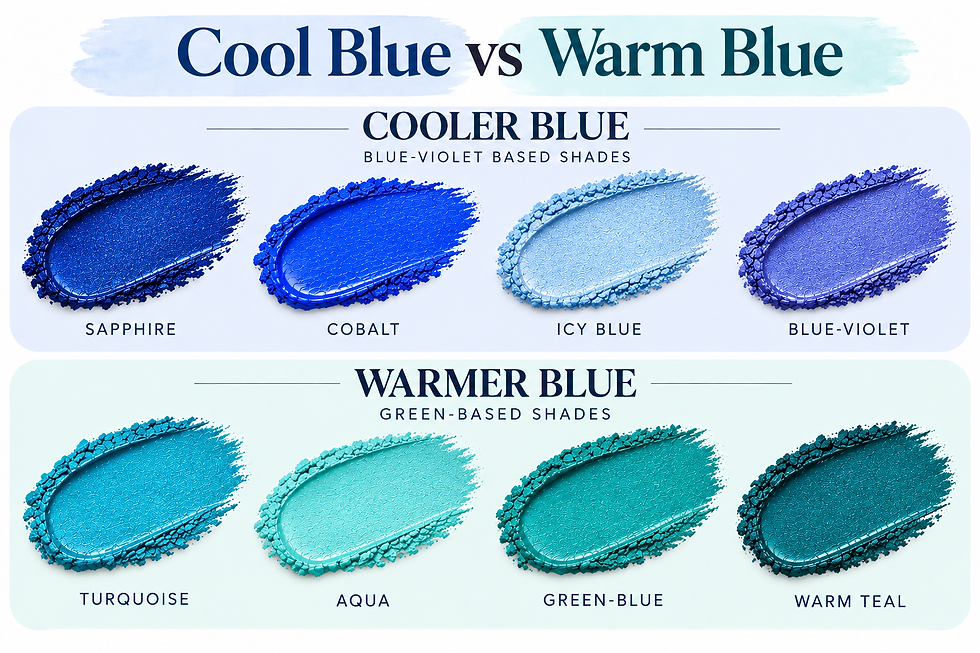
Blue is a cool color overall, but individual blues can still be cooler or warmer relative to one another.
A blue that moves toward violet tends to appear cooler, while adding more green or yellow influence moves blue toward turquoise, aqua, or teal.
Think of the difference between a crisp sapphire blue and a tropical turquoise.
They're both blue-based colors, but they don't have the same temperature.
This idea of relative temperature is important because color analysis isn't as simple as dividing a box of crayons into "warm" and "cool."
Cool Purple vs Warm Purple
Purple can shift considerably depending on whether blue or red dominates the mixture.
Cool purples tend to move toward blue and violet. Lavender, violet, cool plum, and blue-purple are good examples.
As purple becomes increasingly red-influenced, it moves toward the warmer side of the purple family.
This is another reason simply saying "purple looks good on cool undertones" isn't particularly helpful.
Which purple?
That's the question that matters.

Cool White vs Warm White
Here's one you've probably encountered in traditional undertone tests.
Hold a piece of crisp white fabric near your face. Then try cream or ivory.
Cool whites are crisp, bright, and sometimes almost blue-white. Warm whites have more yellow, beige, or creamy undertones.
If you have cool undertones, crisp white may make your complexion appear clearer and brighter, while cream can sometimes cast a yellowish tone.
Warm coloring often comes alive beside ivory and cream.
But don't treat this as a foolproof undertone test. Lighting, hair color, makeup, surrounding colors, and even the exact shade of white can affect what you're seeing.
It's one clue, not a diagnosis.

Silver vs Gold: Does Jewelry Really Reveal Your Undertone?
You've probably heard this one a thousand times: silver means you're cool and gold means you're warm.
There's some truth behind the idea, but it's not a rule.
Silver, platinum, and white gold have a naturally cooler appearance. Traditional yellow gold has a warmer appearance.
Someone with very cool coloring may notice that silver seems to blend beautifully with their complexion while yellow gold looks more separate from it. Someone with warm coloring may experience exactly the opposite.
But personal preference matters too.
Liking gold jewelry doesn't make you warm-toned. I wore gold jewelry for years and switched mainly to silver. But my mother just gave me a family heirloom (a gold ring) and you'd better believe I'll be wearing it, even if it's not super flattering on me. It's special.
Plenty of people, particularly those with neutral or olive undertones, can wear multiple metals beautifully.
Use jewelry as another piece of evidence rather than letting it decide your entire undertone.

Cool Undertones vs Warm Makeup Colors
This is where knowing the difference becomes especially useful.
Makeup sits directly against your complexion, so subtle undertones can suddenly become much more obvious.
For blush, cool options include rose, berry, mauve, and blue-pink, while warmer blushes include peach, coral, apricot, and warm terracotta.
For lipstick, look at blue-red, berry, plum, mauve, and cool pink versus tomato red, coral, peach, orange-red, and warm nude.
For eyeshadow, compare taupe, charcoal, cool brown, plum, and silver with copper, bronze, warm brown, gold, and peach.
And then there's bronzer and contour, which are definitely not interchangeable. A golden bronzer adds warmth. A cooler taupe-brown contour mimics shadow.
Once you know what you're looking for, makeup shopping becomes considerably easier.

Cool Undertones vs Warm Color Chart
Here's the cheat sheet.
Color | Cooler Shades | Warmer Shades |
Pink | Fuchsia, raspberry, cool rose | Coral, peach, salmon |
Red | Blue-red, cherry, cranberry | Tomato, poppy, orange-red |
Nude | Mauve, rosy beige, taupe | Peach, caramel, golden beige |
Brown | Mushroom, taupe, espresso | Camel, cinnamon, chestnut |
Green | Emerald, pine, blue-green | Olive, moss, yellow-green |
Blue | Sapphire, cobalt, blue-violet | Turquoise, aqua, green-blue |
Purple | Violet, lavender, blue-purple | Red-purple, warm orchid |
White | Crisp white, blue-white | Cream, ivory, ecru |
Metal | Silver, platinum, white gold | Yellow gold, antique gold |
What If You Look Good in Both Cool and Warm Colors?
You might!
Undertones aren't always dramatically cool or warm. Some people fall closer to neutral, while olive skin can make traditional undertone tests particularly confusing.
Your overall color season also involves more than temperature. Depth, contrast, and chroma all affect which colors are especially flattering.
That's why you shouldn't decide you're warm simply because one gold necklace looks great, or cool because someone once told you that you have blue veins.
Look for patterns.
Do several cool pinks flatter you more than peach? Does crisp white consistently look better than cream? Do blue-red lipsticks work while orange-red shades seem to wear you instead?
Those repeated patterns tell you far more than one isolated test.
Still Not Sure If You Have Cool or Warm Undertones?
Seeing cool undertones vs warm side by side is one of the easiest ways to understand color temperature, but figuring out where your skin falls can still take some detective work.
That's exactly why I created the Pale Cool Beauty Cool Undertone Quiz.
It walks you through several characteristics rather than relying on one old-school trick, and it can help you figure out whether cool coloring might explain why certain makeup and clothing colors consistently work better for you.
And once you know your undertone, don't stop there. Your (also FREE) seasonal color palette can narrow things down even further, helping you find the specific cool or warm colors that suit your overall coloring best.
Cool Undertones vs Warm FAQs
What is the main difference between cool and warm undertones?
Cool undertones tend to have more pink, blue, red, or violet influence, while warm undertones tend to lean golden, yellow, peach, or orange. Undertone is separate from skin depth, so fair, medium, and deep skin can all have cool or warm undertones.
How can I tell if a color is cool or warm?
Compare it with another shade from the same color family. A raspberry pink looks cooler beside a peachy coral, while a blue-red looks cooler beside a tomato red. Looking at colors side by side is often much easier than trying to judge a shade on its own.
What colors usually look best on cool undertones?
Cool undertones often work beautifully with blue-based pinks and reds, berry shades, mauve, cool taupe, emerald, sapphire, violet, crisp white, silver, and other colors with blue, pink, or violet influences. Your color season can narrow those choices down even further.
What colors usually look best on warm undertones?
Warm undertones often suit peach, coral, tomato red, caramel, golden brown, olive, cream, ivory, and other shades with yellow, peach, orange, or golden influences. The best shades will also depend on the rest of your coloring.
Can you have both cool and warm undertones?
Your undertone doesn't usually switch between cool and warm, but some people fall closer to neutral and can wear colors from both sides beautifully. Olive skin can also make the usual warm-versus-cool tests a little trickier.
Why does warm makeup sometimes look orange on cool skin?
Warm makeup often contains peach, yellow, golden, or orange pigments. Against cool skin, that warmth can become much more noticeable, which is why a nude lipstick, foundation, blush, or bronzer that looks neutral in the package can suddenly pull orange.
Is silver or gold better for cool undertones?
Silver, platinum, and white gold often harmonize especially well with cool undertones, while yellow gold tends to complement warmer coloring. But jewelry is only one clue. If you love gold and have cool undertones, you absolutely don't have to stop wearing it.


Comments